Print This Post

great fountain geyser

great fountain geyser

Yellowstone National Park

September3, 2010

Yellowstone is always steaming, fuming and erupting somewhere.  This is the great fountain geyser as it erupts sporadically every 9 to 12 hours.   As the geyser gets ready to erupt the water in the center starts to boil and overflow to fill the fountain tables.  It is truly amazing to watch.   We enjoyed waiting for the eruption and hit up a conversation with a couple from England.

Great Fountain Geyser sits in the middle of one of the prettiest sinter formations in the park. The sinter forms a series of terraced concentric reflecting pools around the geyser.  Even if the geyser isn’t erupting, it is worth driving past to see the pools.

Great Fountain is a fountain-type geyser, erupting in a series of bursts through a pool of water. Its interval between eruptions ranges from 9 to 15 hours but its short term average interval is usually stable enough that the eruptions can be predicted to within an hour or two. Great Fountain’s maximum height ranges from about 75 feet to over 220 feet. Its duration is usually about one hour but durations of over two hours have been seen.

Great Fountain is a major geyser, but many people, when hearing it erupts to over 200 feet, are disappointed by its more common maximum of less than 100 feet. For this reason, Great Fountain has earned a number of pejoratives, such as The Flounder. The smaller eruptions of Great Fountain are still large and pretty but pale in comparison to the truly huge eruptions.

Great Fountain erupts in a series of distinctly spaced bursts. The first group of bursts lasts about ten minutes. Then there is about a five minute quiet period followed by another five or so minutes of activity. These quiet and active episodes continue until the end of the eruption. Usually the first period of activity is the tallest and strongest, with the first and sometimes the second burst being the strongest of the eruption. Sometimes, the largest burst will occur during the third active period. This especially seems to occur when the first period has been uninspiring. Rarely, large bursts will continue long into the eruption.

Great Fountain is the only major geyser you can truly watch from your windshield. This is especially nice in bad weather.

Print This Post

Old Faithful

Old Faithful Yellowstone NP

Yellowstone National Park

August 28, 2010

On our first day into the park we left early to tour the Madison River section to the Geyser area. Yellowstone is truly amazing.  In the first half hour we watched a herd of elk graving in an open field along the beautiful blue Madison River.  There were buffalo along the way and one lonesome fellow heading to the river for a drink along a trail I am certain he has traveled many times.  The thermals in park are always a treat to view with the steam rising with the heat and sulfur smell.

With Brad’s usual good timing, we walked up to Old Faithful just as it erupted.  Beautiful treat to witness.  The crowds are down right now as the people are usually 5 deep to witness the display.

We camped out at the Great Fountain Geyser as it was scheduled to erupt in less than a half hour.  It is not as regular as Old Faithful and erupts every 9 to 13 hours.  It was a sight to see the steam start to build as the water filled the fountain tables and shot about 20 jets of water and steam.  It was a different eruption than we witnessed 2 years ago as it had only three big bursts.

Looking forward to exploring more of the park in the coming days.

Print This Post

Superfund site

_dsc0705_6_7-beverley-pit-_tonemapped.jpg

Butte, Montana

August 25, 2010

The trolley tour of the historic mining town of Butte, Montana was very enjoyable.  The town has a very unique historical and mining district.  This weird color photo is of the super fund site called the Beverly Pit.  The water has a copper color due to the copper mining run off.

The town has a boom and bust mining era that made a few great fortunes and took many lives.  I will include more info as time allows.  We are off to Yellowstone tomorrow.

Print This Post

Harper Bridge

harper bridge Missoula MT

Missoula, Montana

August 18, 2010

The best laid plans often go astray especially when it comes to jeeping forest service roads on  national forest lands.  We struck out three times today on the back roads.  Early this morning we attempted to drive to the Montana Snowbowl (a ski area) but the road was completely closed for construction.  The other road up the mountain was gated a short way up and only open to hikers.  As my new forest service map shows, many of the roads in the Rattlesnake National Forest and Lolo National Forest are only open to hikers.   Our final strike was Harper Bridge which appeared on my Montana atlas, Garmin GPS and the National Forest Service map.  As you can see from the pic this bridge has been history for awhile.  We did see a jeep on the other side but did not feel the jeep Gods where smiling on us today and did not attempt the water crossing.

We are enjoying Missoula’s many restaurants and shopping areas.  Brad has tasted his favorite Moose Drool brewed here in Missoula and a thin crispy crust pizza so life is good.

Print This Post

The National Bison Range

Montana

August 5, 2010

“Oh, give me a home where the buffalo roam

buffalo love

and the deer and the antelope play…

deer and fawn

antelope

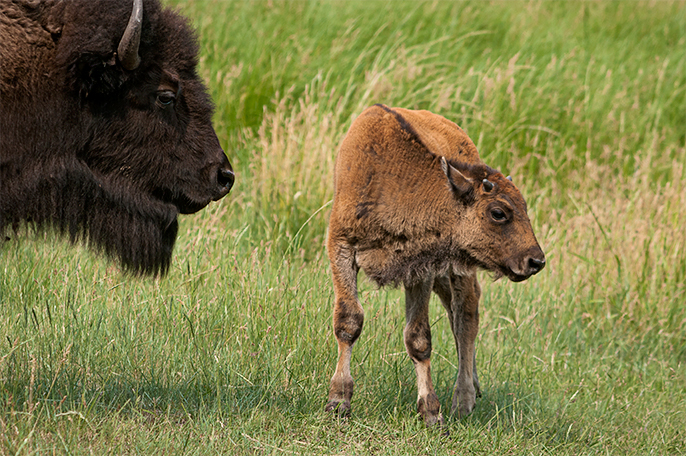
Found ourselves singing this song as we took a wonderfully scenic ride through the National Bison Range in Montana today.  The landscape was pristine prairie with many original grasses.  The 19 mile one-way gravel road called Red Sleep had amazing vistas at every elevation and switchback.  The land, the sky and the light were simply gorgeous.  I have posted a few of the critters we saw.

The ranger warned us to stay in our jeep and not get out in buffalo areas.  The rutting season has begun in earnest and we witnessed many energetic encounters by the bulls.  We saw clouds of dust rising in the air as the big boys displayed dominance in the herd.  After getting some pics, we moved on as the herd was all stirred up, the grunting snorting and deep calls were a little intimidating with only the jeep between us and a couple hundred large buffalo.

The National Bison Range was established in 1908 in response to concern that the buffalo had been slaughtered to the point of extinction.  Part of the original herd was purchased from the Conrad family of Kalispell, Montana, who were early buffalo ranchers,  The animals are now flourishing here and the bison roundup is held in early October at the Bison Range.  The Bison Range is on a parcel of land carved from the Flathead Indian Reservation. To the east is the Mission Mountain range and the south the Bitterroot Mountains can be seen.

Print This Post

Flathead Lake

flathead lake

Polson, Montana

July 31, 2010

We have landed in Polson Montana on the southern shores of Flathead Lake.  The Mission mountain range flanks the eastern shores on the lake and make great cherry orchard country.  At 28 miles long, 7-8 miles wide, and more than 300 feet deep the Flathead Lake is the larges natural freshwater lake west of the Mississippi.

Back to the cherries….  The first white settlers on the eastern banks of the lake arrived in 1891 and quickly hit on the idea of growing cherries there.   Fruit orchards were established all along the eastern shore of the lake.  Although they’re subject to periodic killing frosts, Flathead Lake’s cherry trees are productive enough to supply farm stands and roadside vendors around the region.  That is until we showed up!  These smaller deeper red cherries are tart and tasty.